Hello readers, this blog is a part of a thinking activity assigned by Megha Ma’aam, in this blog you will find critical analysis of Rabindranath Tagore’s novella “Ghare Baire”, also known as “The Home and The World”.
Rabindranath Tagore (1861-1941)
Rabindranath Tagore is an Indian poet, polymath, novelist and philosopher from West Bengal. He is one of the legendary figures in Indian Writing in English in the pre-independence era of India. Tagore was educated at home but for higher education went to England. In his later years, alongside his various literary works, he took care of his family estates, which allowed him to connect with everyday people and deepened his interest in social reforms. He also founded an experimental school at Shantiniketan, where he applied his Upanishadic educational ideals.
Tagore also participated in the Indian nationalistic movement, but his views of nationalism are different from many of his contemporaries as portrayed in his novel “The Home and The World”. Tagore achieved early success as a writer in Bengal. When he translated some of his poems, he quickly gained recognition in the West. His fame grew immensely, leading him to travel across continents for lectures and building friendships. Globally, he was seen as the voice of India's spiritual heritage, and in India, particularly in Bengal, he became a significant, respected figure.
His poetry collection ‘Gitanjali’ is world famous, and for this anthology of poems he got the Nobel Prize in literature in 1913. He is the first non-Europian to win a Nobel prize in literature. Tagore was knighted by the ruling British Government in 1915, but within a few years he resigned the honour as a protest against British policies in India.
Rabindranath Tagore's literary works include
Poetry: Manasi (1890) [The Ideal One], Sonar Tari (1894) [The Golden Boat], Gitanjali (1910) [Song Offerings], Gitimalya (1914) [Wreath of Songs], and Balaka (1916) [The Flight of Cranes].
His English translations include The Gardener (1913), Fruit-Gathering (1916), and The Fugitive (1921), though these do not directly correspond to individual Bengali volumes. Gitanjali: Song Offerings (1912), despite its name, contains poems from multiple works.
Plays: Major works include Raja (1910) [The King of the Dark Chamber], Dakghar (1912) [The Post Office], Achalayatan (1912) [The Immovable], Muktadhara (1922) [The Waterfall], and Raktakaravi (1926) [Red Oleanders].
Novels: His notable novels are Gora (1910), Ghare-Baire (1916) [The Home and the World], and Yogayog (1929).
The Home and The World: Overview
Major Characters: Nikhilesh, Bimla, and Sandip
Minor Characters: Choto Rani, Bado Rani, Chandranathbabu, Miss Gilby, Amulya, and Panchu.
The novel “The Home and The World” is set against the backdrop of Bengal’s Swadeshi Movement and its arbitrary partition by Lord Curzon, and it is received with bitter communalism and plotting between Hindu and Muslim community. The novel focuses on the married life of two characters Nikhilesh and Bimla, and how their life changes after nationalistic Sandip’s arrive at their home. The story is about the difference of opinion about the swadeshi movement of Nikhil and Sandip.
Nikhil’s understanding of swadeshi movement is very nuanced and deep, he was caring towards poor Muslim peasants who are working in his farm. Whereas, Sandip’s views are superficial, and he does not think twice about the repercussions of his actions. They are like binary one is patriotic other is nationalistic, one is Ram, other is Ravan.
The novel is loose allegory of Bengal’s swadeshi movement, and through each character Tagore talks about different views of the movement. Through Nikhil, Tagore presented his own view regarding the swadeshi movement.
Major Concern of The Novel
Swadeshi is described as,
"a flood, breaking down barriers and sweeping away all caution and fear."
Although ‘The Home and the World” by Tagore has some literary flaws, it remains an important novel for understanding his views on the dangers of political extremism. The story centers on the swadeshi movement in Bengal, which called for the use of only Indian-made goods and a rejection of foreign products. Tagore portrays the swadeshi movement as a symbol of his belief that organized political movements are often beyond individual control.
Rabindranath Tagore' and Nationalism as Presented by Nikhil
Rabindranath Tagore’s Nationalism in India and The Sunset of the Century offer timeless insights into nationalism, freedom, and history. Their warnings about the dangers of nationalism and the broader vision of true freedom are even more relevant today than when they were written over a century ago.
Even though from childhood I had been taught that the idolatry of Nation is almost better than reverence for God and humanity, I believe I have outgrown that teaching, and it is my conviction that my countrymen will gain truly their India by fighting against that education which teaches them that a country is greater than the ideals of humanity.
According to Desai, Tagore believed that the boycott of cheap British goods in favor of more expensive Indian goods was hurting the poor, particularly Muslim peasants and traders, who were disadvantaged by wealthy Hindu landowners and politicians. However, in his narrative, Tagore seems to overlook the strong patriotic sentiments of many Indians who supported the Swadeshi movement as a form of resistance against colonial rule. This omission led to a negative response from many readers.
Critical Analysis of The Novel
"The Home and The World" is also considered as a political novel because of it's portrayal of communalism and swadeshi movement. The novel's title is both symbolic and metaphoric. Nikhil is a landlord with progressive views about women and their education, and therefore he wanted to introduce Bimla to the outside world. The female character Bimla is made to step across the boundary from the the private, caring, safely, lovely and domestic space traditionally reserved for women in Indian families into the public world of politics, fear, problematic and uncertainty.
Nikhil is portrayed as a kind and open-minded landowner, often seen as a reflection of Tagore himself. In contrast, Sandip symbolizes the passionate yet ruthless and self-centered nationalistic revolutionary. These three characters Nikhil, Sandip, and Bimala act like figures in a morality play, each representing different values. Through them, Tagore expresses his controversial opinions on nationalism and the Swadeshi movement.
In the novel, Bimla crosses the threshold of home and went into the politically governed outside world, which is represented by Sandip. Initially, Bimla is confused with this kind of approach of Nikhil, but soon after meeting Sandip and hearing his speech on swadeshi movement, she is bewitched by his eloquence and charm. She is instantly attracted towards him, and his views of nationalism.
Bimla's character is undoubtably at the center of all happenings in the novel, symbolizing Bengal at a crossroads. Through her personal struggle, Tagore allegorizes the nation's conflict and its broader challenges. Nikhil with his broad minded views about both nationalism and women's education wanted to teach the ways of outside world to Bimla. She is getting English education under European teacher Miss Gilby. She learns to read and write in English. Slowly and steadily the effects of partition is started to unfold, and we see the unrest of Bengali people manifesting in violence, and in such violence one student attacks Miss Gilby.
She is fascinated to Sandip's charismatic personality, and soon started to meeting him, and also adopt Sandip's political and pseudo-nationalistic views without thinking of her own. She blindly follows Sandip and his way of dealing with nationalism, that includes boycott of foreign goods, even burning them occasionally. Their main aim is to promote Indian or swadeshi made things like Khadi. At first glance this seems very genuine protest, but Sandip is not thinking about those poor farm labors who can not afford costly Indian goods like sugar and cloths. For them, cheap and easily available foreign goods are like boon, and removing them from the market would only make their condition worse. Only Nikhil possess such foresightedness, and thinks about the poor families. We see that Sandip is also somewhere aware about the fact that his views are not in favor of poor people yet he does not concern himself with this matter. This makes his character problematic and also the counter figure of Nikhil.
"mind. I would make my country
a Person, and call her Mother, Goddess, Durga—for whom I would redden the earth with
sacrificial offerings."
Moreover, this novel also put forth the issue of gender. In the novel, Bimla is represented as goddess, and seen as Bharatmata by Sandip. He seen county as women to be loved.
"True patriotism will never be roused in our countrymen unless they can
visualize the motherland. We must make a goddess of her."
Such are the views of Sandip. He knows how to handle people and deceive them into a false nationalism, and he uses mass to fulfill his purpose and desire. He knows how to manipulate people in the name of patriotism and motherland.
At the end of the novel, we see that Bimla is getting closer and closer to Sandip, and she started meeting him in absence of Nikhil. She is driven by nationalistic views of swadeshi movement and her love towards Sandip. She is confused whether she loves Sandip or his ideology. She is unable to decide between Nikhil and Sandip. Her situation is much like Hamlet's 'To be or not to be'.
It is only at the fag end of the novel that she realizes that Nikhil's views are appropriate and for greater good of poor and lower class people. Tagore concludes the novella by condemning the movement through the characters' fates, which reinforce the allegory of the narrative. Nikhil suffers a fatal wound, Sandip cowardly flees to the North after causing conflict, and Bimala faces a future of loneliness, desolation, and guilt. In the end, both Bimala and Bengal are left without a sense of belonging or purpose without a home or a world.
Symbols in The Novel
Uses of different symbols allows Tagore to allegorically represent the conflicts between tradition and modernity, nationalism and humanism, that were affecting Bengal and India during the period of partition and swadeshi movement. The characters and their actions become emblematic of larger social and political forces.
Bimala - She symbolizes Bengal itself, torn between tradition and modernity. Her character represents the nation at a crossroads.
Nikhil - He symbolizes traditional Indian values and ethics, as well as Tagore's own views. He represents a more moderate, humanistic approach to nationalism.
Sandip - He symbolizes the aggressive, violent form of nationalism that Tagore criticized. He represents the dangers of extreme patriotism.
The home - Symbolizes tradition, the private sphere, and the old way of life in India.
The world - Symbolizes modernity, the public sphere, and new Western influences entering India.
The act of stealing - Symbolizes the corruption of values in the name of nationalism.
Durga/Kali - The goddesses that Bimala is compared to, symbolizing how nationalism deifies the nation/woman.
Bimala crossing the threshold - Symbolizes Bengal's transition from the private, traditional sphere to the public, political sphere.
Key Themes
Nationalism vs. Humanism: The novel explores the conflict between aggressive nationalism (represented by Sandip) and a more humanistic, ethical approach to patriotism (represented by Nikhil).
Tradition vs. Modernity: This is symbolized through the contrast between "the home" (tradition) and "the world" (modernity), as well as Bimala's transition between these spheres.
The Role of Women in Society: The novel examines the changing status of women in Indian society, particularly through Bimala's character and her emergence from purdah.
The Dangers of Extreme Patriotism: Tagore criticizes the violent and destructive aspects of the Swadeshi movement, warning against the perils of unchecked nationalism.
East vs. West: Tagore examines the impact of Western ideas on Indian society and the need to balance Eastern and Western values.
We also had movie screening of this movie, which further helped us to understand the character portrayal of Sandip, and overall understanding of the novel.
Here is You Tube link of the movie if you want to watch,
Hello, this blog post presents my understanding of Sarvepalli Radhakrishnan's views on Hindu philosophy, his ideas regarding an idealistic life, and his overall contribution to Indian philosophy. In this task, I will be answering a few questions assigned by Prakruti Ma'am.
Sarvepalli Radhakrishnan: The Messenger of Indian Philosophy (1888-1975)
Radhakrishnan was an academician, philosopher and former Indian precedent. He is one of the most famous and recognized Indian philosopher and thinker, whose works draws heavily from Indian old scriptures like Vedanta and Upnishadas. His works primarily defends the beliefs of Hindu religion, and it practices and traditions. Radhakrishnan also represented Indian at the global level in the universities like Manchester college, Oxford. During the time when Britishers saw Indian as an orient and uncivilized, neglected our culture and practices, at that time Radhakrishnan's works were seen with respect and restored the dignity of Hindu culture and tradition. He is often considered as the bridge builder between Eastern and Western society and thoughts.
Radhakrishnan's Perspective of Hinduism
The first question is that why it is needed to defend the Hinduism?... during which Radhakrishnan writes this works. It is because Hinduism and it ethics somewhere felt backwards to the British people. India was colony of British, and therefore Indian people, their value, tradition, culture, and even religion was considered as inferior in compare to Christian religion. Initially there was a rift between both the religions, and therefore Radhakrishnan needed to defend the Hinduism against the Western views of Englishmen.
“The challenge of Christian critics impelled me to make a study of Hinduism and find out what is living and what is dead in it… I prepared a thesis on the Ethics of the Vedanta, which was intended to be a reply to the charge that the Vedanta system had no room for ethics”
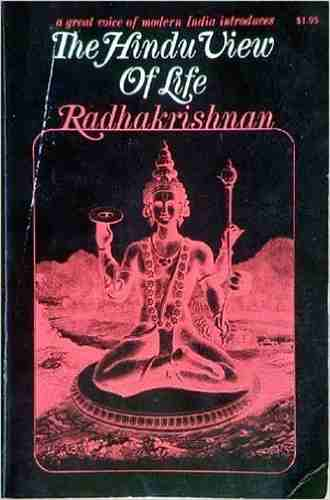
This thing is talked about in his seminal work "The Hindu View of Life" which is divided into four sections, and each talks about various aspects of Hinduism. In that he explains what is Hinduism and it's doctrine, and adds that there is not a single specific definition of Hinduism as it was geographically named from 'Sindhu Sanskriti'. So the term Hindu is came from Sindhu, a similar kind of word which was a local name for Indus river.
Moreover, he defines Hinduism as a way of living life, and puts Hinduism in modern context to increase it's relevance in the contemporary time. He also asserts that Hinduism is done not believe in a single God. There are many Gods in Hindu religion and tradition, which started from the ancients time when various natural elements were worshiped by Aryans. In this sense Hinduism is polytheistic religion in comparison to other Abrahminic religions like Islam and Christianity, who are monotheistic religions.
'Hinduism is a philosophically coherent and ethically viable philosophy and religion'
Radhakrishnan also put emphasis on the tolerance of the Hindu people. He talks about trust based on doubt in which he says that people believes something but also questions it. This argument places Hindu religion in intellectual framework. Radhakrishnan and his works strived for improving the image of Hinduism. His views are now seen as much idealistic and somewhat problematic.
Write a note on the contribution of S. Radhakrishnan in Indian Writing in English.
Radhakrishnan is one of celebrated thinker and philosopher of India. His contribution to Indian Writing in English is immense, especially his views related to philosophy and idealist life. His philosophy as mentioned earlier took many things from ancient Indian texts and scriptures. He used those texts, and interpreted them in the modern context which is relevant to the problems faced by many peoples in today's time.
He advocated for philosophy of absolute idealism, and Advaita Vedanta. He believed that human being is more than matter, he is not only an observer but an essential part of the universe. he believed that human beings are spiritual beings rather than religions beings. He also believed that human being has that capacity to live ahead of himself, which can only be attained through spiritual awakening of inner self. He also gives examples of Budhha, Jesus, and Mohomet who achieved such kind of spiritual ability. His philosophy and his idealism is seems very much utopian to us now, and somewhat problematic because there are not much people who follows such kind of absolute idealism in their way of living life.
He also contributed in the betterment of education as well, and on his birthday we celebrates National Teacher's Day on 5th September. He also was the chairperson of Radhakrishnan commission which came immediately after the India's independence. For Radhakrishnan, the best way to build a united and strong India was through university education that helped individuals grow fully. In the 1930s and 1940s, he shared his idea of an independent India. He believed that India should be led by people who were educated and committed to awakening the country’s sense of identity and purpose.
According to Radhakrishnan, What is the Function of Philosophy?
To simply put, Radhakrishnan's philosophy is and idealist, spiritual and transcendental. In his work "An Idealist View of Life" he talks about his philosophy. He believed that universe is spiritually driving at something that has a meaning and value. The idea of assumption is at the center of any philosophy, and all philosophy is idealistic as said by German philosopher Hegel. This is also true for Radhakrishnan's views. His views are also idealistic (sometime unbelievable and problematic because of his various assumptions) where he says that humans can live beyond themselves. They have to awaken the inner divine from within.
He also talked about the reality. He believed that everything is a necessary part of one single reality. According to him God is not the supreme reality, but the divinity within ourselves is the supreme or transcendental reality.
During this journey of knowing oneself needs knowledge, and it's source is sense experience, intellectual cognition, and intuitive apprehension. Among them sense experience can be acquire from external forces. Through analysis and synthesis one can achieve intellectual cognition. The thing is neither of these able to help you in achieve the ultimate reality.
Personally, this philosophy is seems artificial because there is no one who has achieved such kind of supreme reality(not even Radhakrishnan who believes in such kind of abstract philosophy), at least in contemporary times.
Thank you for visiting...
References:
Nivasulu Reddy, P., and Sarvepalli Radhakrishnan. “A Critical Analysis of ‘The Hindu View of Life’ by Dr. Sarvepalli Radhakrishnan.” Online International Interdisciplinary Research Journal, vol. IV, no. II, journal-article, Mar. 2014, p. 337. www.oiirj.org/oiirj/mar-apr2014/45.pdf?authuser=0.
After completing the unit on Postcolonialism, we moved on to our next unit and have now completed the study of Salman Rushdie's groundbreaking, Booker Prize-winning novel "Midnight's Children". This novel is particularly important because of its new Postcolonial insights, as it explores the ideas of hybridity, chutnification, magic realism and historical metafiction. In this blog post, you'll find some points to ponder upon, which have been assigned by Dr. Dilip Barad.
Justification of the Title: Analyze why Salman Rushdie chose the title "Midnight's Children" over "Children of Midnight".
"A novel in which memory and politics, love and hate would mingle on almost every page".
"Midnight's Children" novel deals with many problems and issues, and it sort of fictionalize the history of India from 1920 up to the end of Emergency in 1977. Background of the novel tell the story of incidents that were really happened in Indian history, and foreground consist of imaginary characters.
The protagonist of the novel is Saleem Sinai, is known as a "Midnight's Child," which highlights his link with other children born at midnight and symbolizes the experiences and challenges of India's new generation. The newspaper cutting with the headline "Midnight's Child" announces the birth of a child who represents India's new start after the independence, and he is also the narrator telling his story to his wife Padma, and she also gives commentary about the things unfolding in the novel. Saleem tells the story of four generation of his family including himself.
Saleem Sinai is one of the children of midnight. Those are the children with special power and they are the 'embodiment of the hope of freedom'. All the midnight's children are born on the same date of India's independence on 15th August, 1947, at midnight during 12 to 1 A.M., There are thousand and one midnight's children out there. Saleem, Shiva and Parvati are most important of them. There is constant rift between Saleem and Shiva, because Saleem was born exactly on 12 AM, and Shiva five minutes after that, and therefore less powerful. Saleem had a special power in his nose with which he can summon all the other midnight's children including Shiva.
If we look historically then, all these children were born at the dawn of new and independent Indian nation, free from oppressions of British raj. These all children were born on the auspicious day of independence, which itself make them special. Rushdie here, give them special powers, and it seems that their future is bright with this new India. But the things were different, after the independence India had new challenges. The 1965 War between India and Pakistan, liberation of East-Pakistan, and the emergency.
Salman Rushdie somehow needed a title for his novel about children born at midnight which better serves his purpose in storytelling and the way he wanted to narrate the story of India and that of Saleem simultaneously. 15th August, 1947 midnight was the time of significant change in India, that title is driving force of narrative and also adds depth to the magic realism aspect of the novel. "Midnight's Children" was a suitable choice than "Children of Midnight" because it has a deeper meaning and significance. The title "Midnight's Children" is more suitable than other.
Role of 'English' in the Novel
Robert Phillipson had highlighted the dangers imposing language on others in his 1992 work 'Linguistic Imperialism'. Linguistic imperialism refers to the practice of imposing one language on people who speak different languages. It's also called linguistic nationalism, linguistic dominance, or language imperialism. In today's world, the spread of English globally is often highlighted as the main example of this phenomenon.
"the dominance asserted and maintained by the establishment and continuous reconstitution of structural and cultural inequalities between English and other languages."
Today, English language is commonly cited for linguistic imperialism. Nowadays it is important for everyone to know and learn English language to have good opportunities in market jobs. Those people who knows this language are seen as intellectual and superior than others, especially in India and Eastern countries. Most of the countries from East were once the colonies of Britishers, and during that time English people imposed their language and culture upon the Indians. In return, to impress their master Indians have started to learn, speak and write English language. This way English language holds more importance today not only in India but globally.
In 'Midnight’s Children', Salman Rushdie's character Saleem Sinai used English in a way that was both remarkable and recognizable to Indians. After years of struggling with this foreign language out of respect for the legacy of Thomas Macaulay, it had finally become something that belonged to them. novelists such as Mulk Raj Anand, R.K. Narayan and Raja Rao were those who made a conscious decision to write in English as if it were an Indian language.(Narayan)
According to Peter Barry, there are three stages in postcolonial discourse, and those are adopt, adapt and adept respectively. In the first stage colonized tries to please their master by adopting their way of living. In the second stage colonized people begin to modify and adapt the cultural and linguistic practices they have adopted from the colonizers. Indian English literature's Adept phase was started with the publication of 'Midnight's Children' and famous preface of Raja Rao's 'Kanthapura'. In this stage colonized people finally master colonizers ways of doing thing and become rebellious in their nature towards their masters.
Rushdie had 'Dedoxified' the English language in his work. In that he breaks the reverence towards the English language in his work. He diminishes the so called respectableness of the English language, and employed many Indian words as it is in the novel. This way of putting Indian words as it is in the English works is now known as "Chutnification" of language. Rushdie has used English language, there is no denying in that, but he used very Indianized version of the language.
Midnight’s Children drew some of its manic essence from GV Desani’s 'All About H Hatterr'. “Hatterr’s dazzling, puzzling, leaping prose is the first genuine effort to go beyond the Englishness of the English language,” Rushdie wrote in The New Yorker.
The question of language was central to the making of Midnight’s Children. However, writing in classical English felt wrong, like a misrepresentation of the rich linguistic environment of the book’s setting. In the end I used fewer non-English words than I originally intended. Sentence structure, the flow and rhythm of the language, ended up being more useful, I thought, in my quest to write in an English that wasn’t owned by the English (Rushdie)
He took the inspiration from American writer Philip Roth, who used such kind of hybridity of language and mixing of words from various languages. Rushdie thought that the using of proper English language would not give the justice to Indian English novel.
Here is the example of hybridity of language used by Rushdie, kind of a "Hinglish". Mingle of English and Hindi language. Look at the highlighted words.
She (Padma) attempts to cajole me from my desk : "Eat,
na, food is spoiling." I remained stubbornly hunched on
paper . . . . Padma snorts. Wrist smacks across forehead.
"Okay, starve, starve, who cares two pice."
'All right, all right, baba,' Padma attempts to placate me. 'Why become
so cross? Rest now, rest some while, that is all I am asking.'
'Hey, you Saleem: just to think! You and me, mister-midnight's
children, yaar! That's something, no?'
Metaphor of ‘Bulldozer’ used in Midnight’s Children
The reference to "bulldozers" is a symbol of the harsh and forceful way the government tries to modernize society in Salman Rushdie's 'Midnight's Children'. The bulldozers represent the destruction of poor or marginalized communities in the name of progress during the years of emergency (1975-1977). They are being used to clear out the "ghetto of the magicians," showing how the state is willing to erase people's homes and cultures to make way for what they consider development.
This connects to a larger theme in the novel, where modernization and nation-building often come at the expense of ordinary people, especially those who are already vulnerable, poor and helpless. The bulldozer here is a symbol of how power can destroy people's lives in the name of progress.
The major concern in the text is how political power can dehumanize and silence marginalized people. The bulldozer not only demolishes homes but also crushes memories, histories, and resistance, illustrating how authoritarian regimes prioritize their agendas over the well-being of citizens, often under the guise of beautification or improvement.
This is also true of the current government in India, where the threat of the bulldozer is used to silence people, particularly minority communities like Muslims. If anyone speaks out against the interests of the government or authority, it can have severe consequences for their livelihood. Thus, the bulldozer becomes a tool to silence people and strip away their freedom of expression.
Postcolonial Voices in Midnight’s Children
"Midnight’s Children" offers critical insights and new perspectives within postcolonial studies. The novel predominantly explores the hybridization of identity in the cases of both central figures, Saleem and Shiva, while also delving into linguistic experimentation and historiographic metafiction.
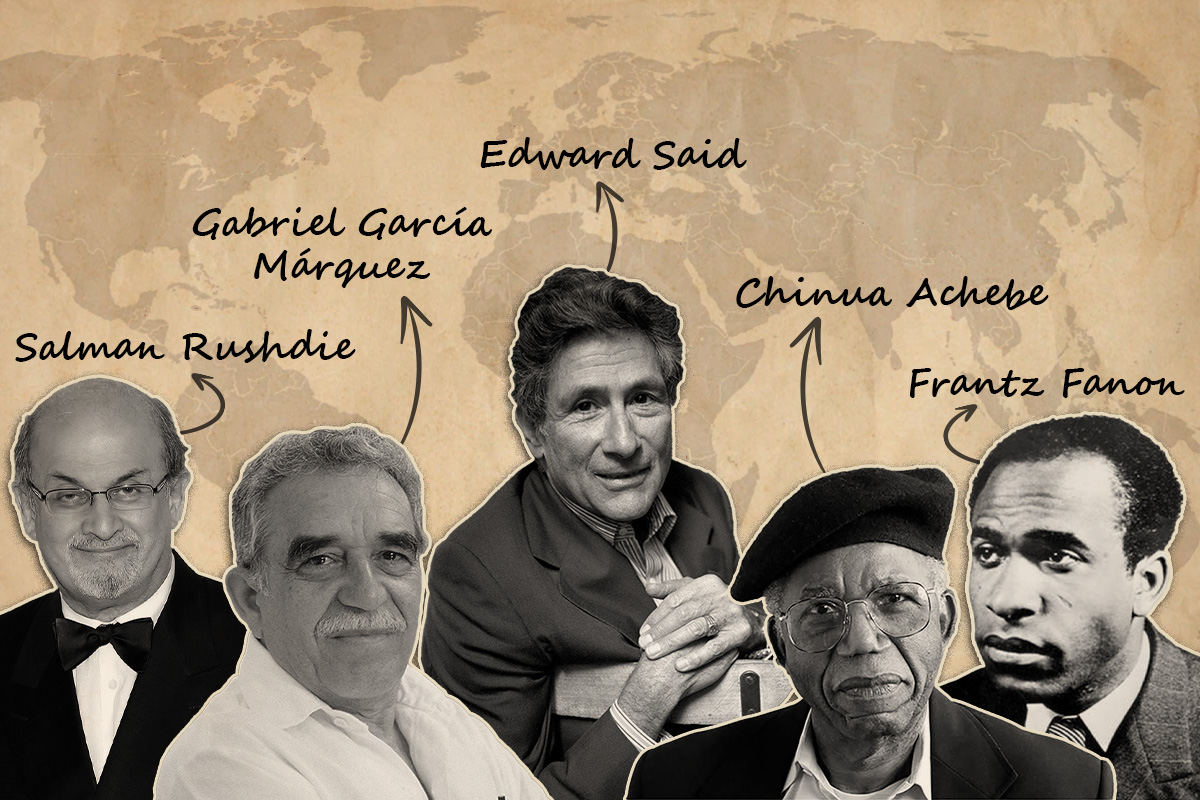
In many ways, Rushdie breaks from traditional postcolonial representations. The novel focuses on the indigenous character Saleem's history, with the entire narrative revolving around him. In contrast, the traditional portrayal of postcolonialism often involves numerous Western characters and a continuous conflict between the colonized and colonizers, as seen in 'A Passage to India' by E.M. Forster, where multiple foreign characters are central. However, in 'Midnight’s Children,' the only prominent Western character is William Methwold. This way, Rushdie subverts Edward Said's Orientalist framework.
As mentioned above, Rushdie and his works represent the Adept phase of postcolonialism, in which the writing not only addresses indigenous culture but also intermingles it with the culture of the colonizers. This intersection of identities leads to the concept of “Hybridization,” introduced by Homi Bhabha. In 'Midnight's Children', we observe the hybridized identities of Saleem and Shiva. Aadam Sinai believes that Saleem is his son, while he is actually the child of William Methwold and Vanita. Conversely, Shiva, the biological child of Aadam and Amina, is raised by the poor entertainer Wee Willie Winkie. Throughout the novel, the true identities of both Saleem and Shiva remain uncertain, only revealed when Mary Pereira confesses to swapping the children at birth. This highlights the hybridized identities of the characters, who are neither fully Indian nor fully Westernized.
Typically, the poor, marginalized, and subaltern are voiceless or given little space in narratives, but in this novel, we see that Saleem’s character emerges from a lower-class background. Yet, the entire story revolves around his character development, with Indian history interwoven with the events of his life, from childhood to adulthood. On a psychological level, Saleem’s fractured and diseased identity allegorizes the challenges faced by India after gaining independence in 1947. While people believed that India would rise to new heights, the nation faced numerous struggles. Indians witnessed regressive historical events, such as Partition, the India-Pakistan war, the Bangladesh Liberation War, and the Emergency imposed by Indira Gandhi. These events are crucial in shaping both the nation's history and Saleem’s psychological development.
The novel also successfully decenters the European way of presenting narratives. The entire story focuses on Indian history and its people, rather than centering the narrative around Western thought. This is achieved through the use of magic realism and chutnification at the linguistic level. The hybridized, chutnified language is evidence of a process of decolonizing the self, allowing for a new perspective that moves beyond the colonial lens.
Reflection on Emergency Period
In the novel, Rushdie also comments about the regressive event of emergency from 1975 to 77 in the tenure of Indira Gandhi, which is now considered as a black spot on Indian democracy. Back then she was very much famous and popular politician figure among Indian people. These two years of her reign as prime minister of India can be regarded as dictatorship, where there is no one to speak against her, and she was the only supreme authority figure. This is a significant event of Indian history, and it is also captured in the novel also, but in very much satirical manner.
Rushdie had made direct reference to Indira Gandhi as 'The Widow' in the novel. This also led to court case and other legal frame work between Rushdie and Indira Gandhi. In the novel she is portrayed as authoritative figure. In the movie also, she orders to arrest all the midnight's children, because of this Saleem was suffered in the prison along with other children.
Katherine Franke is the biographer of Indira Gandhi. She had written Indira: The Life of Indira Nehru Gandhi., in which she has written good and bad aspects of Indira Gandhi openly. Indira Gandhi's embarrassing incident with Margaret Thatcher over lunch is famously captured by her. In that event Rushdie also was invited but he did not went there. Such was the character of Indira Gandhi portrayed by Salman Rushdie.
This blog is dedicated to the virtual Teacher's Day celebration organized by the students of the Department of English at MKBU. Within this post, I have attached my presentation, along with the full recording of the video lesson. Additionally, a quiz related to the lecture will be provided, which can also be accessed on Ted-Ed. Upon watching the video, participants are encouraged to take the quiz, after which an auto-generated e-certificate will be sent to their email upon successful completion.