Thursday, 17 April 2025

Translating Indian Internet Memes: Strategies, Challenges & Cultural Adaptation


Translating Indian Internet Memes: Strategies, Challenges & Cultural Adaptation


Name:- Aakash Chavda

Batch:- M.A. Sem 4 (2023-2025) 

Enrollment Number:-5108230011 

E-mail Address:-aakashchavda637@gmail.com

Roll Number:- 01


Assignment Details:


Topic:- Translating Indian Internet Memes: Strategies, Challenges & Cultural Adaptation 

Paper & subject code:- Paper 208: Comparative Literature & Translation Studies

Submitted to:- Smt. Sujata Binoy Gardi, Department of English, MKBU, Bhavnagar


Abstract


This paper explores how Indian internet memes are translated across languages, focusing on strategies used to adapt humor and cultural references. Using a qualitative approach grounded in Translation Studies theories—such as Venuti’s domestication/foreignization and Skopos theory—the research analyzes three popular memes. Findings highlight the use of literal translation, adaptive rewriting, and caption-based explanation to navigate cultural gaps. The study shows that meme translation is a creative process of cultural negotiation, revealing the translator’s key role in shaping digital humor for diverse audiences.


Keywords: Meme, translation, popular culture. 

Objectives

  • What translation strategies do practitioners use for Indian memes?

  • How do those strategies reshape humor, cultural reference, and user reception?

What is a Meme?

A meme is a unit of cultural transmission that spreads from person to person through imitation or repetition. Richard Dawkins first coined the term in his 1976 book The Selfish Gene, describing memes as self-replicating cultural units, akin to genes in biology (Dawkins, 1976). Initially, memes were not internet-bound—they have existed for centuries as symbolic modes of expression, such as inside jokes, jingles, or social references

In today’s digital culture, memes are largely visual texts—often images or short videos with superimposed captions—used to convey humor, satire, or commentary. Saint Hoax, a meme creator, defines them as media repurposed to deliver cultural or political messages, often aligned with the zeitgeist.

Brief History and Rise in India

India’s meme culture began gaining prominence with increased access to the internet in the early 2000s. Platforms like Orkut, Facebook, and later Instagram enabled user-generated content to flourish. Early meme trends in India included light humor around Bollywood and regional jokes, evolving into political commentary, social critique, and mass participatory content. Memes like “Gormint Aunty,” “Chai Peelo,” and Bollywood-centric humor like “Hera Pheri” references became viral phenomena, showcasing the localization of meme content. (Nihalani)

In India, memes serve as tools of cultural dialogue and self-expression. They bridge the gap between traditional media and contemporary digital vernacular. With platforms such as Instagram and Twitter, memes are now embedded in political discourse, social commentary, and even branding and marketing strategies. They form a participatory culture, fostering a sense of belonging among youth while shaping public perception.

Theoretical Framework

This study is grounded in two key translation theories: Skopos theory by Hans Vermeer and the domestication/foreignization model by Lawrence Venuti.

Skopos theory (Vermeer, 1989) emphasizes that translation should be guided by its purpose or intended function. In the context of meme translation, the goal could range from entertaining to informing, and the chosen strategy should align with this aim. For example, a meme intended to entertain a global audience may require cultural adaptation to ensure the humor is understood.

Lawrence Venuti’s (1995) framework distinguishes between domestication, which adapts the text to the target culture, and foreignization, which retains elements of the source culture to preserve its originality. These strategies are especially relevant in translating Indian memes, which often contain culturally specific references, idioms, or humor. Translators must decide whether to localize content for accessibility or preserve its original flavor for authenticity.

Together, these theories help analyze how and why meme translations are adapted, recontextualized, or preserved across languages and cultures.

1. "Jaldi bol kal subah Panvel nikalna hai" Meme 
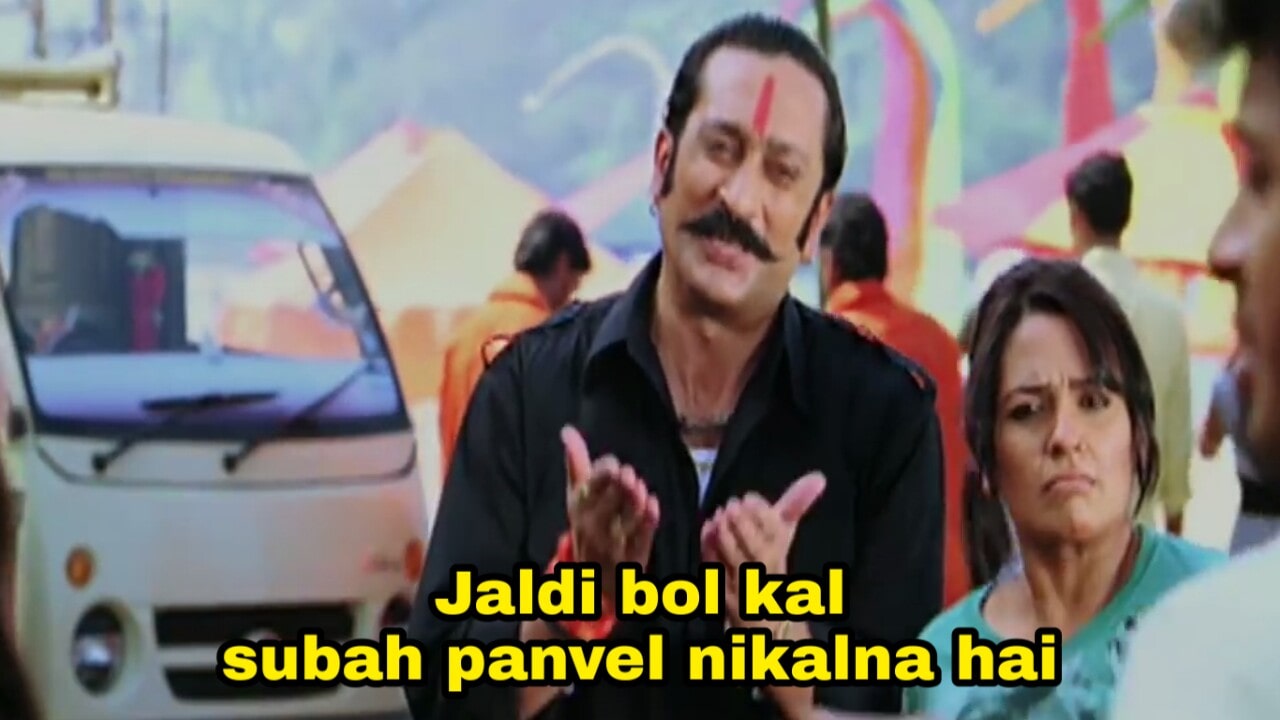
This meme features a character Vasooli Bhai pleading dramatically, accompanied by the text "Jaldi bol kal subah Panvel nikalna hai," a line loaded with urgency and mild threat. The humor is amplified by the exaggerated hand gestures, stern expression, and use of bold yellow Devanagari-style captioning. The composition directs the viewer’s attention instantly to the textual punchline, relying on both image-text interplay and visual hierarchy to drive the joke. Here, “Panvel” as a location carries implicit meaning: a far-off place often humorously associated with escape or exile in urban Indian narratives. The joke only lands if the viewer understands both the geographic and cinematic connotation of a place Panvel.

A direct translation like “Speak quickly, I have to leave for Panvel tomorrow morning” strips the line of its menace and rhythm. Literal translations may be semantically accurate but pragmatically flat. Therefore, transcreation is the most fitting strategy—perhaps something like “Spit it out, I’m catching a flight to nowhere tomorrow”—preserving the comic threat and time pressure while localizing references. 

Understanding this meme also requires background knowledge of the movie and character dynamics. The humor and intimidation in the original line stem not just from the words, but from the character’s body language, tone, and context within the scene. As suggested in the Multimodal Discourse Analysis framework, meaning emerges from a blend of text, image, layout, and cultural cues—and translation must adjust accordingly.

This punchline has transcended its original setting and become a humorous way to express impatience in everyday Indian life, especially when someone is taking too long and there’s a time crunch. In a high-context culture like India, where shared cinematic references are common, a phrase like this functions as a playful shorthand for “Hurry up, I don’t have all day”—making the meme both linguistically rich and socially relevant.


2. “Dil cheez kya hai, aap meri jaan lijiye / Jaan cheez kya hai, aap mera aashirwad lijiye” Meme 
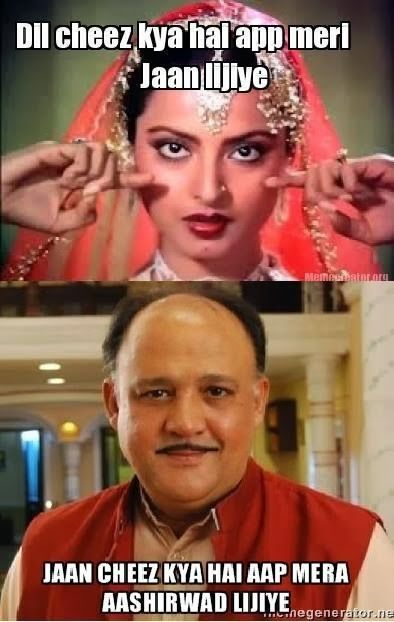

This meme masterfully plays with Bollywood stereotypes and internet irony, forming a visual-textual pun through the juxtaposition of two culturally loaded images. In the first panel, Rekha—an iconic figure of Bollywood romance—delivers her famous poetic line from Umrao Jaan: “Dil cheez kya hai, aap meri jaan lijiye” (“What is a heart? Take my life instead”). The second panel sharply contrasts this with Alok Nath, widely known for his 'sanskaari' (morally upright) roles, offering an unexpected, parody-style reply: “Jaan cheez kya hai, aap mera aashirwad lijiye” (“What is life? Take my blessings instead”).

The humor emerges from semantic inversion and visual dissonance, further supported by timing and panel sequencing, as outlined in Multimodal Discourse Analysis. The use of culturally embedded references is a prime example of what Edward Hall defines as high-context communication, where understanding depends on deep cultural familiarity.

From a translation studies perspective, this meme illustrates Lawrence Venuti’s concept of domestication vs. foreignization. A literal translation of the text might preserve the language but fail to communicate the layered humor, which is deeply tied to Indian pop-cultural consciousness. To make this meme work across cultures, a domestication strategy is required—cultural substitution of both characters and idioms. This aligns with Skopos theory, which prioritizes the purpose of the translation—in this case, to evoke the same comedic and ironic effect in the target audience, even if the textual and visual elements are significantly altered.

Moreover, the meme takes on a darker, satirical tone when contextualized against the backdrop of Alok Nath’s involvement in India’s #MeToo movement. Once hailed as the embodiment of virtue and paternal wisdom in Indian cinema, his image was dramatically re-coded after allegations of sexual misconduct surfaced. This adds a biting layer of dark humor: the phrase “aap mera aashirwad lijiye” (“take my blessings”) becomes uncomfortably ironic, making the meme a subtle form of social commentary on hypocrisy and moral duality in celebrity culture.

In this sense, the meme functions not only as a pop-cultural joke but also as a critical reflection—satirizing the very ideals its characters once symbolized. The translation and interpretation of such a meme require more than linguistic accuracy; they demand cultural literacy and contextual sensitivity.


2. Rasode Me Koun Tha Meme 
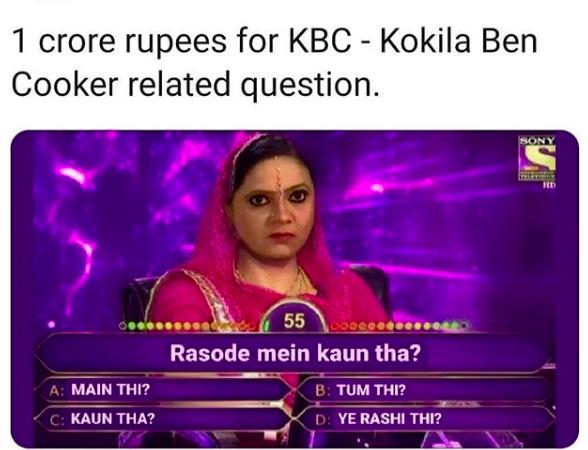
The meme “Rasode mein kaun tha?” cleverly fuses two icons of Indian pop culture: a melodramatic soap-opera moment featuring Kokila Ben’s famous line (“Who was in the kitchen?”) and the quiz show format of Kaun Banega Crorepati (KBC). By placing Kokila’s intense expression within the familiar game show setup—with lifelines, timers, and multiple-choice options—the meme turns a petty household accusation into a ₹1 crore question. The humor emerges from this absurd elevation of trivial drama to win money for giving answers to seemingly nonsensical questions , powered by cultural recognition and visual parody.

The meme’s impact depends heavily on multimodal elements: bold fonts, familiar color schemes, and Kokila’s unchanged glare all work together to heighten the joke. But it also relies on high-context knowledge: viewers must know the original soap-opera scene, the significance of “Rashi,” and the aesthetics of KBC. For non-Indian or unfamiliar audiences, this context may be lost—making translation a challenge.

Literal translation preserves structure but can sound awkward (“This Rashi?”). Adaptive versions risk diluting the original charm. A balanced solution is to keep the Hindi text and add a small caption (e.g., “Rashi = daughter-in-law”) to bridge the gap without over-explaining.

Crucially, this meme also reflects the rise of “brain rot” humor online—where meaning takes a backseat to surreal repetition and exaggerated drama. The original soap line was never that deep, yet its remix went viral for being oddly hypnotic and hilariously over-serious. That lack of meaning becomes part of the joke. Translators must recognize that the humor here isn’t just in the words—it’s in the absurdity of treating nonsense with gravity. This meme shows that translating Indian internet humor is about more than words—it’s about preserving vibe, context, and chaos.

Conclusion 

This study set out to explore the strategies translators use when adapting Indian internet memes, and how those choices reshape humor, cultural meaning, and audience engagement. The findings suggest that meme translation is a multimodal and deeply contextual process. Literal translations often flatten the joke, while adaptive or caption-based strategies allow humor and intent to survive across cultural borders. Each meme required not just linguistic skill, but cultural sensitivity and creative problem-solving—aligning closely with both Skopos theory and Venuti’s domestication/foreignization model.

Interestingly, the “Rasode mein kaun tha?” meme also illustrated how humor online is increasingly shaped by surreal, “brain rot” aesthetics—where the meaninglessness of content becomes part of the comedic effect. In such cases, translation becomes less about exact replication and more about preserving vibe, tone, and absurdity.

meme translation is less a matter of word-for-word conversion and more an act of cultural storytelling—where the translator is not just a linguistic bridge, but a curator of shared laughter in a digitally fragmented world.

References 

Benveniste, Alexis. “What Is a Meme? The Meaning and History.” The New York Times, 14 February 2022, https://www.nytimes.com/2022/01/26/crosswords/what-is-a-meme.html#. Accessed 17 April 2025.

Catford, J. C. “Translation Shifts”. The Translation Studies Reader. Ed. Lawrence Venuti. London: Routledge, 2000: 141 – 148.

Dawkins, Richard. The Selfish Gene. Oxford University Press, 2016.

Kemppanen, Hannu, et al. “Domestication and Foreignization in Translation Studies.” Frank & Timme. https://www.ciando.com/img/books/extract/3865969690_lp.pdf. Accessed 17 April 2025.

Nihalani, Bishakha. “Meme Culture in India- History, Importance & Famous Memes.” Yeh Hai India, 5 July 2020, https://yehaindia.com/meme-culture-in-india-history-importance-famous-memes/. Accessed 17 April 2025.

Reiss, Katharina, and Hans Josef Vermeer. Towards a General Theory of Translational Action: Skopos Theory Explained. Edited by Marina Dudenhöfer, translated by Christiane Nord and Marina Dudenhöfer, St. Jerome Publishing, 2013.


Saturday, 22 March 2025

The Revenant (2015) | Movie Review

"The Revenant" (2015) is an intense, visceral experience that combines survival, revenge, and the brutal beauty of nature. Directed by Mexican filmmaker Alejandro González Iñárritu. The film highlights profound themes of human endurance and colonial exploitation. Watching Leonardo's films has always been a compelling experience for me—whether it's The Great Gatsby, The Departed, Killing of the Flower Moon, Shutter Island, or Inception. However, I missed one of his recent movies (and many other also), The Revenant, which I watched recently. The film won three prestigious awards in 2016 right after its release . In this blog, I will review the movie.

Released in 2015, At first, the movie may seem like just another action-packed film. However, as the narrative progresses, its depth becomes clear. Set in the snow-covered mountains of America during the winter, the cinematography by Emmanuel Lubezki captures the serene yet harsh beauty of the landscape. The awe-inspiring scenery makes the film feel authentic and, for those who love snow-covered mountains, a visual treat.


The central conflict of the film revolves around the tension between Native American tribes [Ree] and white settlers, who considered the natives as "savages" and sought to impose "civility" on them. The military crew exploited the natives, taking their land, animals, and even their wives, often resorting to mass murder. In reality, it is the white settlers who need to be "civilized" rather than the other way around. This issue of exploitation is not limited to America—it still persists in places like India, where tribal communities and their land are often exploited in the name of "development." The Naxalite–Maoist insurgency, oft-spoken issue by social activists like Arundhati Roy, is one such example, and the tribal people of Andaman and Nicobar are also facing similar struggles.

Historically, after the 'discovery' of the American continent, white settlers colonized the native tribes. The land that once belonged to indigenous people was taken from them, and their identity, traditions, and way of life were stripped away. Today, although life has significantly improved for many indigenous people through various government reservations, films like The Revenant are important in addressing the ongoing legacy of these issues.


The title of the movie, "Revenant," refers to one who comes back from the dead, and the story revolves around Hugh Glass, played by Leonardo DiCaprio. After being brutally attacked by a grizzly bear, Glass is left for dead by his crew, including Captain Andrew Henry (Domhnall Gleeson). Despite his severe injuries, Glass survives the bitter winter, enduring unimaginable pain and hardship. DiCaprio's portrayal of Hugh Glass is masterful, blending raw emotion with resilience. Tom Hardy, as the ruthless and cunning Fitzgerald, also delivers an outstanding performance.


In later part, the film becomes a revenge tragedy when Glass’s son is killed by Fitzgerald. What follows is a relentless pursuit of vengeance. While this theme of revenge is central to the plot, the film also teaches us about human survival instincts in the most extreme conditions. At times, it felt like watching Man vs. Wild, with Glass using every survival skill to stay alive in the wilderness. Thankfully, the film’s powerful performances and the stunning landscapes prevent the audience from feeling disconnected from the narrative.


The movie explores the raw cruelty of nature and the survival-of-the-fittest mentality. Fitzgerald, driven by the same though, abandons Glass to die. Later, the remaining crew members are scattered due to differences in survival strategies. Glass's journey involves extreme acts of survival, such as eating raw meat and using the skin of animals for warmth. These scenes emphasizes the brutal relationship between humans and nature, where survival often means killing animals for sustenance.


After enduring so much physical and emotional pain, including hallucinations of his dead wife and son, Glass finally reaches Fitzgerald to seek his revenge. However, the movie poignantly suggests that revenge, in the end, cannot undo the loss of his son. This adds to the film’s deeper insight on the futility of vengeance and the toll it takes.


The movie is about the primal instincts of human nature, survival, the brutality of nature, and the consequences of colonialism. Anyways, the movie is worth watching, especially if you're a fan of Leonardo DiCaprio and his acting. 


Here you can check out the trailer...


Thank you...


{Note: I have utilized ChatGPT for the language and grammar enhancement}

Thursday, 20 March 2025

"When Breath Becomes Air" by Paul Kalanithi | Book Review

Hello,


I recently completed reading this book titled "When Breath Becomes Air". It was published posthumously in 2016 as a memoir written by Paul Kalanithi. Although I had read a few non-fictional works before, this book was an entirely new experience for me. Paul Kalanithi was an American neurosurgeon and writer, deeply interested in literature, mortality, and the meaning of life. He completed his master’s in English Literature at Stanford University before pursuing medical training.


This book offers an intimate glimpse into Paul’s most intense and personal moments with his wife, family, and friends. He was living a dream life until he was diagnosed with stage IV lung cancer. The memoir stands as a testament to his passion for literature and his unwavering commitment to his patients and his duties as a doctor. The narrative is rich with intertextual references to various literary works that shaped Paul’s perspective on life and death. His love for reading was instilled in him by his mother during his childhood.

The title itself is compelling enough to draw readers in. Breathing is an essential and ceaseless act for human beings yet, in the face of death, it becomes nothing more than mere air. The book grapples with profound questions: Is it possible to find meaning and purpose in life when standing at the brink of death? When we know we have only a few months left, how do we make sense of our existence? This memoir offers an answer.

Paul describes his life as an intersection of biology, philosophy, literature, and mortality. He was obsessed with understanding the meaning of life, death, and the workings of the human brain, which is why he chose neurosurgery—a field where science and mortality constantly intertwine. The book is filled with medical terminology and disease names that can be difficult to pronounce, adding to its authenticity. Another key aspect of the memoir is its exploration of medical ethics and the doctor-patient relationship. Paul provides a detailed account of his journey from an undergraduate student to a neurosurgical resident, frequently called upon in emergency cases. The advice he once gave to his patients now applied to him, as he found himself on the other side, in the shoes of a patient.

The book features a foreword by Dr. Abraham Verghese and a heart-wrenching epilogue written by Paul’s wife, Lucy Kalanithi. Structurally, the memoir is divided into two parts, with the latter focusing more on Paul’s mental state after his diagnosis. He describes how treatments like chemotherapy made him physically weak, yet he remained mentally strong, preparing himself for the struggles ahead. It was in the midst of this conflict that he wrote this book, encapsulating both his life and his illness.

I believe that death is something we all fear, even if we deny it. As human beings, our fundamental instinct is to survive as long as possible. In the face of death, there comes a moment when we think of ourselves and our loved ones, and our imagined future with them—we want to live. For Paul, the birth of his daughter, Cady, gave him a renewed sense of purpose and a meaning to his life, even in the little time he had left.

"Paul faced each stage of his illness with grace—not with bravado or a misguided faith that he would ‘overcome’ or ‘beat’ cancer, but with an authenticity that allowed him to grieve the loss of the future he had planned and forge a new one."


This excerpt from the book reflects his resilience. He did not take a blind leap of faith but faced his reality fearlessly and vulnerably. In such moments of disaster we come to realize the importance of humans relationships and family. It was because of this Paul was able to live a little bit longer. Stories like this remind us that ‘death need not be proud’.


Thank you for visiting...

Tuesday, 18 March 2025

What is Literature and How Literature Shaped Me?

Hello,

This blog is a response to a task assigned by Prof. Dilip Barad. In this post, I will share my perspective on the question, "What is literature?", reflect on how literature has influenced me, and present my own metaphor for literature.


What is Literature?

Literature, in its traditional sense, encompasses a wide range of written works, including novels, dramas, prose, and poetry. Initially, stories were passed down through oral traditions, ensuring their preservation for future generations. However, the invention of printing technology in Europe during the 15th century revolutionized the dissemination of knowledge, paving the way for the Enlightenment. From that point onward, literature evolved through the modern and postmodern periods, and today, we find ourselves in a technologically driven, "flat" world. In this new era, literature has acquired novel forms, with machines now capable of generating poetry and stories using AI technology. It was amidst this transformation that I first became familiar with literature.


Interestingly, I was not familiar with the term "literature" until I enrolled in a B.A. program. Even during my bachelor’s studies, I wasn’t particularly inclined toward literature and perceived it as merely stories about kings and queens. However, in the last semester of my degree, I found myself drawn to English literature and books. This fascination deepened during my master’s studies, especially after being introduced to cultural studies, critical theories, and absurd and existential philosophy.


Literature is often regarded as a way of understanding and living life. It exerts a gradual yet profound impact on individuals. In my case, studying and engaging with critical theories and philosophy has played a crucial role in shaping my worldview and understanding of how human society functions. I personally believe that studying and reading literary texts makes one more mature than those who do not engage with such works. At the same time, reading literature and watching quality films fosters empathy and kindness toward fellow human beings. It allows one to understand people and their ways of thinking. I think one of the most paramount values that literature teaches us is to be kind and helpful to everyone.


Moreover, literature serves as a guide, helping us avoid wrong decisions by offering a moral compass through the actions of its characters. From the virtuous paths of noble characters, we learn how to navigate the boat of our own lives, while flawed characters like Macbeth warn us against the perils of unchecked ambition and greed. Similarly, figures like Victor Frankenstein and Dr. Jekyll caution us against indulging in reckless scientific pursuits without considering their consequences. Jay Gatsby vividly illustrates the dangers of clinging to the past, teaching us to embrace the present rather than be consumed by unattainable dreams.


I have always been particularly fascinated by politics, authority, and the construct of human behavior. During my study of cultural studies and literary theories, I had the opportunity to explore the writings of Michel Foucault, Louis Althusser, Frederic Jameson, Frantz Fanon, and Jacques Derrida. Their views and philosophies on the world, the individual, and society changed my perspective, allowing me to see things in a different light. It has often been said that literature and politics go hand in hand. The connection between literature and politics is deeply rooted in history, where writers, poets, and playwrights have used their works as tools to challenge authority, inspire revolutions, or critique social and political systems. Anti-colonial and feminist literature are prime examples of this, along with works written against the dangers of totalitarianism by writers like George Orwell. The influence of European literature also led to the establishment of the Indian Renaissance and nationalist movements. These instances demonstrate that literature is a uniquely powerful medium capable of sparking the force of liberation within an individual's mind. Sadly, however, we have also witnessed the manipulation of literature by those in power, giving rise to propagandist literature. To read and understand literature is to develop a historical sense, and to view contemporary happenings through the lens of literature is an essential practice.


For me, literature is a complex entity that cannot be confined to a single definition. It is a liberating force that penetrates deeply into the mind, forever changing the individual and often leading them into isolation or solitude. This is my perspective on literature after completing my Master’s in English Language and Literature.

Saturday, 1 March 2025

African Poems | ThAct

 Hello, this blog is part of thinking activity on the African poems.


Q)  Write a detailed note on post-colonialism with reference to “Piano and Drum”.


When at break of day at a riverside

I hear jungle drums telegraphing

the mystic rhythm, urgent, raw

like bleeding flesh, speaking of

primal youth and the beginning,

I see the panther ready to pounce,

the leopard snarling about to leap

and the hunters crouch with spears poised.

And my blood ripples, turns torrent,

topples the years and at once I’m 

in my mother’s laps a suckling;

at once I’m walking simple

paths with no innovations

rugged, fashioned with the naked

warmth of hurrying feet and groping hearts

in green leaves and wild flowers pulsing.

Then I hear a wailing piano

solo speaking of complex ways

in tear- furrowed concerto;

of far away lands

and new horizons with

coaxing diminuendo,  counterpoint, 

crescendo, but lost in the labyrinth of its complexities, it ends in the 

middle of a phrase at a daggerpoint

And I lost in the morning mist

of an age at a riverside keep

wandering in the mystic rhythm

of jungle drums and concerto.


Post-Colonialism in Gabriel Okara’s Piano and Drums


Post-colonialism is a critical framework that examines the impact of colonial rule on formerly colonized societies, focusing on themes such as cultural identity, hybridity, neo-colonialism, and resistance. Gabriel Okara’s poem Piano and Drums is a profound reflection of the post-colonial struggle faced by Africans, as they grapple with the effects of Western influence on their indigenous traditions. Through the symbolic contrast between the drums (representing African heritage) and the piano (symbolizing Western civilization), Okara illustrates the cultural dissonance experienced in post-colonial societies.

Cultural Conflict and Identity Crisis

One of the central concerns of post-colonialism is the crisis of identity that arises when a colonized people are forced to adopt a foreign culture. In Piano and Drums, Okara presents this dilemma through the perspective of an individual caught between two worlds. The drums, associated with traditional African life, evoke a sense of simplicity, strength, and unity with nature. The poet describes the drumbeats as having a “mystic rhythm,” linking them to an ancestral past that is raw and uncorrupted. This represents pre-colonial Africa, where cultural identity was deeply rooted in traditions, communal living, and a harmonious relationship with nature.

In contrast, the piano represents Western modernity, bringing with it complexity, alienation, and a detachment from nature. The poet describes the piano’s sound as “wailing,” filled with musical terms like "diminuendo," "counterpoint," and "crescendo," which highlight its intricate yet confusing nature. This reflects the overwhelming and often disorienting experience of post-colonial subjects who find themselves struggling to adapt to Western ways of life while losing touch with their indigenous roots. The overwhelming sophistication of Western culture creates an identity crisis, leaving the speaker caught between nostalgia for the past and the uncertainty of the present.

Neo-Colonialism and Cultural Imperialism

Even after formal decolonization, many African nations continued to experience cultural and economic dependency on the West—a phenomenon known as neo-colonialism. In Piano and Drums, Okara subtly critiques this ongoing Western dominance. The piano, unlike the organic and natural drums, is an imported instrument that requires formal training to understand and play. This reflects how Western education, governance, and economic systems were imposed on African societies, replacing indigenous customs. The poet’s confusion in the final stanza, where he finds himself lost "in the middle of the mist," signifies the disorientation caused by this forced assimilation into a foreign culture.

Furthermore, the Western piano’s discord with the natural African drums highlights the failure of cultural hybridity to create a harmonious identity. Instead of a peaceful coexistence, the two cultures exist in tension, with the traditional ways being overshadowed by the imposed Western values. This is a common theme in post-colonial studies, where native customs and languages are either marginalized or replaced by colonial systems, leading to a loss of indigenous knowledge and self-determination.

The Nostalgia for a Lost African Identity

A recurring theme in post-colonial literature is nostalgia for the pre-colonial past, where indigenous cultures thrived without foreign intervention. In Piano and Drums, the poet’s longing for the drum’s simplicity reflects a deep yearning for a time before colonial intrusion. The imagery of "paths with no innovation" and hunting with "spears poised at the rhythm of the drums" paints a picture of Africa before Western influence—an era of self-sufficiency and cultural purity.

However, the presence of the piano disrupts this idealized vision. The poem suggests that once colonial influence takes hold, there is no returning to a purely traditional way of life. The speaker is no longer able to fully embrace the drums alone, as the Western piano has already become a part of his consciousness. This reflects the post-colonial reality that, despite efforts to reclaim indigenous identity, the influence of colonialism remains deeply ingrained in contemporary African societies.

Gabriel Okara’s Piano and Drums is a powerful post-colonial poem that encapsulates the struggles of identity, cultural conflict, and the lingering effects of colonial rule. Through the contrast between the traditional drums and the foreign piano, Okara presents the post-colonial subject’s dilemma—torn between a nostalgic longing for the past and the unavoidable reality of Westernization. The poem serves as a critique of neo-colonialism and cultural imperialism, while also acknowledging the difficulty of reconciling two vastly different worlds. In doing so, Piano and Drums becomes a poignant exploration of the post-colonial experience, making it a significant work in African literature.


Q) Write a critical note on “To the Negro American Soldiers”.


For Mercer Cook

I did not recognize you in prison under your
………..sad-colored uniform
I did not recognize you under the calabash helmet
………..without style
I did not recognize the whining sound of your
………..iron horses, who drink but do not eat.
And it is no longer the nobility of elephants, it is the
………..the barbaric weight of the prehistoric
………..monsters of the world.

Under your closed face, I did not recognize you.
I only touched the warmth of your brown hand,
………..I called myself “Afrika! ”
And I found once again the lost laughter, I hailed the ancient voices
………..and the roar of Congo waterfalls.
Brothers, I do not know whether you bombed the
………..cathedrals, the pride of Europe,
If you are the lightning of God’s hand that burned
………..Sodom and Gomorrah.
No, you are the messengers of his mercy, the
………..Spring after Winter.
To those who had forgotten how to laugh-only
………..smile obliquely
Who knew nothing but the savory flavor of
………..tears and the vexing stench of blood
You bring the Season of Peace and hope to
………..end of the delay.
And their night is filled with milky sweetness, the blue
………..fields of the sky are covered with flowers, silence sings
………..soothingly.

You bring them the sun. The air beats with whispers
………..liquids and crystalline chirping and beating
………..silky wings
The aerial cities are tepid with nests.
Through the streets joy streamed, the boys play with
………..their dreams
Men dance before of their machines and
………..surprised themselves singing.
Schoolgirls’s eyelids are rose petals, and
………..fruits ripen in the virgins’ breasts
And the women’s hips—Oh, sweetness—
………..grow generously heavy.
Black brothers, warriors whose mouths are flowers that
………..sing
—Oh! the delight to live after Winter—I salute you

………..like messengers of peace.


A Critical Note on “To the Negro American Soldiers” by Léopold Sédar Senghor

Léopold Sédar Senghor’s poem To the Negro American Soldiers is a poignant exploration of identity, racial solidarity, and the paradoxical role of Black soldiers fighting for colonial empires that historically oppressed them. Rooted in the Negritude movement, which Senghor championed, the poem pays tribute to the African American, West Indian, and Senegalese soldiers who served in World War II, many of whom were imprisoned while fighting for European colonial powers. The poem reflects on their sacrifices, their shared heritage, and their potential to bring peace to a war-torn world.

The poem begins with the poet’s initial inability to recognize these soldiers under their "sad-colored uniform" and "calabash helmet," symbolizing the erasure of their individual and cultural identities. Their traditional nobility, once embodied by the African warrior on elephant backs, has been replaced by the "barbaric weight of prehistoric monsters"—a metaphor for the modern war machines they are forced to operate. This transformation highlights the irony of their service: they are fighting a war for nations that have historically dehumanized them. Senghor’s imagery suggests that these Black soldiers, despite their bravery, remain nameless and faceless tools in the hands of imperial powers.

However, the poem gradually shifts in tone, moving from despair to hope. Senghor acknowledges their resilience and strength, calling them "messengers of his mercy" and "the Spring after Winter." This metaphor aligns with Negritude’s philosophy of Black identity as a force of renewal and healing. Senghor envisions these soldiers not as instruments of destruction but as harbingers of peace, capable of teaching the world "mercy in the face of brutalities." Through vibrant imagery, he paints a future where war gives way to harmony—children play freely, men dance, and women flourish in the warmth of a restored world.

A key aspect of the poem is its Biblical allusion to Sodom and Gomorrah, referencing divine destruction as a form of justice. Senghor does not explicitly condemn the actions of these soldiers but questions whether they were instruments of retribution or renewal. This duality reflects the larger postcolonial struggle: should Black people seek retribution for historical injustices, or should they strive for reconciliation and peace? The poem ultimately advocates for the latter, portraying African culture as a moral compass capable of guiding the world toward a more compassionate future.

Senghor’s use of repetition, particularly the phrase “I did not recognize you,” underscores the theme of alienation. These soldiers, despite their sacrifices, remain unrecognized by the societies they serve. However, when the poet finally touches one of them, he calls himself "Afrika!"—a moment of solidarity and rediscovery of shared identity. This moment signifies the Negritude movement’s goal of reclaiming Black pride and unity, despite the fragmentation imposed by colonial histories.

In conclusion, To the Negro American Soldiers is a deeply moving tribute to the resilience of Black soldiers and a broader commentary on the postcolonial condition. It exposes the contradictions of war, the ongoing struggle for recognition, and the hope that Black identity, rather than being erased, can become a source of renewal for the world. Senghor masterfully intertwines history, cultural memory, and poetic vision to craft a piece that resonates beyond its historical context, making it a timeless reflection on race, dignity, and the pursuit of peace.


Work Cited 

Barad, Jheel. “The Piano And The Drums- GABRIEL OKARA.” Blogger, https://blog.jheelbarad.com/2022/12/the-piano-and-drums-gabriel-okara.html. Accessed 1 March 2025.

Khan, Farah. “Leopold Sédar Senghor As A Negritude Poet.” International Journal of Research Publication and Reviews, vol. 5, no. 12, 2024. https://ijrpr.com/uploads/V5ISSUE12/IJRPR36453.pdf. Accessed 1 March 2025.


Literary Theory and Criticism - An Introduction

# Definition and Scope - What is Literary Theory and Criticism? Introduction Literary Theory and Criticism constitute the core of literary s...