Exploring the Hemingway Hero Code in “For Whom the Bell Tolls”
Personal Information:-
Name:- Aakash Chavda
Batch:- M.A. Sem 2 (2023-2025)
Enrollment Number:- 5108230011
E-mail Address:- aakashchavda637@gmail.com
Roll Number:- 1
Assignment Details:-
Topic: Exploring the Hemingway Hero Code in “For Whom the Bell Tolls”
Paper & subject code:- 108 - Literature of Americans
Submitted to:- Smt. Sujata Binoy Gardi, Department of English, MKBU, Bhavnagar.
Date of Submission:- 26 April, 2024
Keywords: Code hero, Hemingway hero, Robert Jordan.
Introduction - Hemingway Code Hero
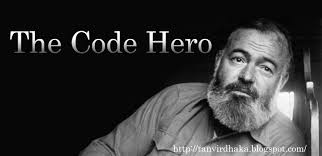
"Hemingway code" refers to the set of principles, moral codes and rules of conduct that Hemingway's fictional heroes adhered to.
The essence of the Hemingway Hero code lies in a unique blend of virtues that define not just characters, but a way of life. At its core lies honesty and grace under pressure, a steadfast courage to confront defeat and pain without succumbing to complaint. This resilience is matched by a deep simplicity, an appreciation for the elemental joys of existence, eating, drinking, sleeping over the labyrinthine complexities of life. For these heroes, meaning is not found in abstract ideals or traditional faith, but in visceral experiences, love, hunting, fishing, bullfighting, that constitute a personal "cult" of fulfilment. Courage, too, is a cornerstone, manifested not only in the face of violence and danger but also in the symbolic "game" against destructive forces, whether as soldiers, hunters, or athletes. Living intensely in the present moment, the distractions of past regrets or future anxieties, finding solitude and purpose in the immediacy of their experiences. And amidst the tumult, they adhere to self-imposed rules, finding victory not solely in outward triumph but in the unwavering commitment to their principles, a testament to the indomitable spirit of the Hemingway Hero.
Connection Between Code Hero and Hemingway’s Own Life Experiences
As we are aware that Hemingway himself was a war veteran and his life was full of adventures, so such kind of war sagas and adventures are expected in his literary works. This is visible in his protagonists famously known as Hemingway’s hero.
We can find a strong connection between the "Hemingway code" evident in his literary works and Hemingway's own life experiences.
War Experience
Hemingway was a soldier in World War I and World War II, serving in dangerous roles. This likely shaped the code's emphasis on courage, risk-taking, and maintaining grace under violent pressure that his fictional heroes display.
Hunting and Fishing
The code values simplicity, living in the moment, and finding meaning through visceral experiences like hunting and fishing. Hemingway was an avid big game hunter in Africa and deep sea fisherman - pursuits he engaged in himself and enshrined in works like The Sun Also Rises and The Old Man and the Sea.
Bullfighting
Attending and writing extensively about bullfighting in works like Death in the Afternoon shaped the code's notions of masculinity, performing under pressure according to self-imposed rules, and facing defeat with stoicism.
Father's Suicide
Hemingway's own father shot himself after struggling with health and financial issues. This deeply affected Hemingway and may have contributed to the code's stance against acts seen as cowardly, but also an understanding of being defeated by overpowering circumstances.
It has been also said that, Hemingway's eventual suicide in 1961 may have been his own final adherence to the code's principles in avoiding a "humiliating" decline from illness. So while fictionalized, the code grew intimately out of Hemingway's own adventurous life trajectory.
Hemingway’s Code: Embodiment of Stoic Masculinity
‘the idea that since there is likely no God or afterlife, one must establish their own ethical code of behaviour to be satisfied with their life's legacy.’
In his famous works of literature, Ernest Hemingway carved out a distinctive archetype - the "code hero", that became an enduring emblem of rugged masculinity and spiritual fortitude in the face of an indifferent universe. As one of the preeminent writers of the Lost Generation, Hemingway witnessed firsthand the disillusionment and existential doubts that plagued the modern age. His response was to craft protagonists bound by an uncompromising "code" of behaviour that imposed meaning and virtue upon an otherwise meaningless existence through sheer force of will.
At the core of the code hero is the ideal of "grace under pressure." Hemingway's quintessential men are world-weary and no strangers to pain, yet they carry themselves with enduring pride, courage and unwavering self-restraint even when defeated. Jake Barnes stoically shoulders his impotence wound in The Sun Also Rises, while the fisherman Santiago in The Old Man and the Sea exhibits almost superhuman endurance against the ravages of nature and age. What defines them is an uncompromising adherence to codes of honor, self-discipline and focused skill whether hunting, boxing, or pursuing other masculine pursuits.
The code hero is locked in a "solitary struggle" against hostile forces he fundamentally does not understand - whether the chaos of war, violence of nature, or cruelty of human society. He knows his fight is ultimately futile and defeat is inescapable. Yet the hero persists, almost obsessively, propelled by an internal sense of purpose that provides his life meaning. As Robert Jordan says in "For Whom the Bell Tolls” while sacrificing himself against Fascism: "As long as you know what you have to do you have to go and do it." Their determination represents a symbolic victory of the human spirit over the uncaring universe.
What Hemingway establishes is a modern framework of existential stoicism, where mortal beings construct their own ethical codes to retain dignity and honor in the face of meaninglessness. The Hemingway hero may lose every worldly possession, but by steadfastly upholding his convictions "with grace under pressure," he maintains an unconquerable nobility. As Santiago's maxim states: "A man can be destroyed but not defeated." This mantra elevates the code hero to an archetype of unflinching masculinity - enduring, self-reliant, skilled and unbroken.
Hemingway's celebrated chronicles drew deeply from his own experiences as a soldier, sportsman and adventurer in crafting these archetypal figures. The code hero represents the author's personal coping philosophy for confronting trauma, disillusionment and mortality through sheer spiritual grit. In giving literary form to this modern ideal of virile perseverance, Hemingway established an influential model of stoic manhood that still captivates readers. The code hero became Hemingway's defiant response to a meaningless world - to lose the battle for survival, perhaps, but to win the last war for human dignity through sheer discipline of character.
Robert Jordan as Hemingway’s Hero
Robert Jordan is the protagonist of one of the famous novels by Ernest Hemingway, “For Whom the Bell Tolls”. The novel revolves around the main task of bowing up the bridge during the Spanish Civil War, the task was assigned by Soviet officer General Golz. Throughout the novel, Jordan demonstrates many characteristics by which we can consider him as Hemingway’s code hero.

Robert Jordan is the main character from Hemingway's novel "For Whom the Bell Tolls", set during the Spanish Civil War. He is an American who hides in caves and wages guerrilla warfare against the fascists.
Robert Jordan represents a development of the tyro figure towards a stronger and more complete character. He embodies a dual role as both an experienced teacher, imparting lessons on warfare and noble qualities like courage and allegiance, and as an inexperienced learner rapidly absorbing life's lessons in an intensified manner. Jordan experiences both victory and defeat, blurring the lines between the two distinct categories of Hemingway heroes, as outlined by Sheridan Baker.
"the young man crushed and defeated by a world he did not make and cannot understand, and the older battered survivor whom many crushings cannot defeat.”
One of the main requirements of being considered as Hemingway’s hero is the they should show both psychological and physical scars. Psychological scar is come from his father’s death, his father had committed suicide in face of adversity and tough situations. Jordan thinks that he also will follows the same footprints as his father, and he is haunted by the thought that he could not face death with courage,
Moreover, he is directly involved with physical violence, the position that Robert Jordan takes against violence is formal and ordered. Jordan is careful to observe the many unwritten rules the guerillas adhere to and his command of colloquial Spanish illustrates how well he has adopted the traditional Spanish way of life. He often comments on how impressive certain things sound when said in Spanish. For example, there is the classical inversion of the sentence, "For us will be the bridge and the battle".
He also lives life completely, 'all the way up', like bullfighters.
As Carlos Baker states,
“A marked 'capacity for life', a full acceptance and love of the world, is always a driving motive with the Hemingway hero."

This capacity for life is intensified and focused into three days. He soon becomes aware that the seventy-two hours he spends with the guerillas could represent a microcosm of his life,
“I suppose it is possible to live as full a life in seventy hours as in seventy years”
The seventy-two hours are to Robert Jordan as the split second of the kill is to a matador. Both are moments of such intense action that time is suspended. There is no wasted movement, no needless expenditure of energy. For Robert Jordan the three days in the mountains come to-stand for the only time of significance in his life. All time is eternally present, and everlasting now.
Robert Jordan as Socialist
Jordan has a fierce belief in the Loyalist cause but when asked if he is a communist he replies, "No I am an anti-fascist". He fights under the communists because he feels that they offer the best discipline for the prosecution of a successful campaign. He has seen the sumptuous life the communist leaders live at the Gaylord Hotel in Madrid and he realizes the discrepancies between the communist ideology and its practical application as a system of government. Although he tells himself that he has no politics, his strong support of the Loyalist movement marks him as a moderate socialist, believing in the freedom, rights, and dignity of the common man. He will not tolerate being called Don Roberto even in jest.
Jordan’s Dedication
Jordan feels he must give strict and unwavering obedience to his superiors even though it may mean following bad orders that cannot possibly be executed. The individual has to subordinate himself and part of his personal autonomy to the general movement of bridge blowing. The Loyalist cause, like religion, demands that one give oneself over totally and unselfishly to the execution of one's duty, in return, one receives a sense of solidarity and brotherhood. The demands of the cause are great, even extending to a form of martyrdom.
"You are instruments to do your duty"
The measure of a man's worth is the degree to which he can sacrifice his own personal ends for the sake of the cause. This may appear to deprecate the individual but, in effect, it is Jordan’s way of achieving the greatest amount of personal expression and fulfilment just as the bullfighter reaches the highest degree of autonomy by working within a rigid framework of unalterable rules. By suppressing personal desires Jordan feels his life is more complete and more whole. In spite of Robert Jordan’s selfless and tireless involvement, there is no place in his devotion to the cause for illusions of grandeur. He truly thinks that he is only an instrument of the Republic and if he can -do his job well and stay alive, all the better.
He possesses the ability to overlook his physical needs while involved in a matter of great importance that demands extreme concentration and sacrifice,
“He was often hungry but he was not usually worried because he did not give any importance to what happened to himself"
He can endure hardship and pass off discomfort lightly without feeling a sense of exaggerated self-importance. As he says in an off-hand manner,
"I am one of those who suffer little”
Use of Alcohol
Like all Hemingway's tyro figures, Robert Jordan makes liberal use of alcohol but he is much more serious in his drinking habits. He drinks absinthe, a very strong, bitter alcohol, which he rations carefully from a hip flask he always guards on his person, It is the one thing he is greedy about, giving out portions sparingly and grudgingly, but he is fortunate in, that it is so strong and bitter that even the hard-drinking guerillas seldom accept his offerings. The drink fits his unique character because of its potency and strength. Jordan treats his absinthe like a precious medicine to be taken only in small doses.
He enjoys the slight escape from reality that it provides him but he does not use it flippantly or overly. He does not let it cloud his judgement and he remains free of a dependency on it, something which is the mark of a strong man.
Conclusion
In conclusion, the exploration of the Hemingway Hero Code through Robert Jordan underscores Hemingway's belief in the resilience of the human spirit. Jordan embodies traits such as courage, simplicity, and perseverance, showcasing Hemingway's own outlook on life as a relentless struggle against adversity. Hemingway's message encourages individuals to confront challenges with fortitude and determination rather than succumbing to despair or seeking refuge in complaint. Through Jordan, Hemingway offers a timeless lesson on the enduring capacity for triumph in the face of adversity.
References
Hemingway, Ernest. For Whom the Bell Tolls. Scribner, 2002.
Malone, Dennis J. “THE DEVELOPMENT OF THE . HEMINGWAY HERO.” MacSphere, Sepetember 1968, https://macsphere.mcmaster.ca/bitstream/11375/9654/1/fulltext.pdf. Accessed 24 Apr 2024.
Motola, Gabriel. “HEMINGWAY’S CODE: LITERATURE AND LIFE.” Modern Fiction Studies, vol. 10, no. 4, 1964, pp. 319–29. JSTOR, http://www.jstor.org/stable/26278764. Accessed 24 Apr. 2024.
Stamberg, Susan, and Ernest Hemingway. “Robert Jordan, Hemingway's Bipartisan Hero.” NPR, 14 October 2008, https://www.npr.org/2008/10/14/95604448/robert-jordan-hemingways-bipartisan-hero. Accessed 24 April 2024.
Young, Philip. “For Whom the Bell Tolls | Novel by Hemingway, Summary, & Facts.” Britannica, 13 March 2024, https://www.britannica.com/topic/For-Whom-the-Bell-Tolls-novel-by-Hemingway. Accessed 24 April 2024.
Zheng, Xin. “Study on the Images of the Code Hero Fighting Alone in Hemingway’s Works.” Theory and Practice in Language Studies, vol. 9, no. 3, 2029, pp. 319-324. Academic Publication, https://www.academypublication.com/issues2/tpls/vol09/03/10.pdf. Accessed 24 April 2024.


.jpg)